
Mille Fleur: A Portrait of 20th-Century Bourgeois Colonial Life
- Annalisa Whitfield
- May 3
- 3 min read


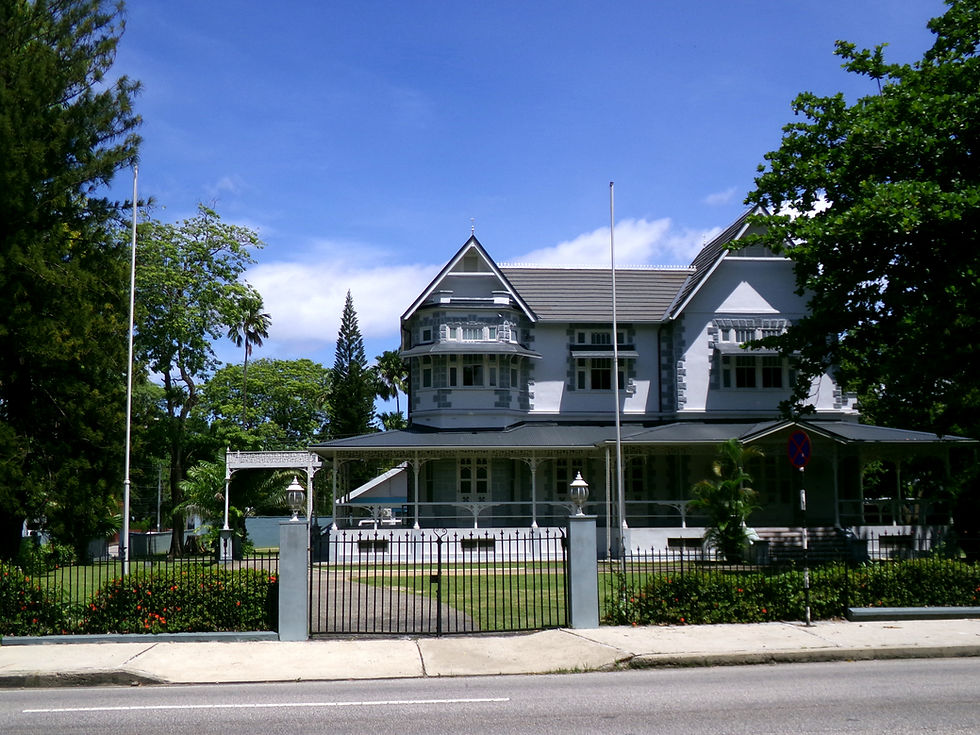
Mille Fleur calls to mind a time in Trinidad’s history when the elite class reflected very European sensibilities. The upper classes were likely to be of French or British descent, foreign-born, and foreign-educated. Everything from architecture to daily attire was representative of the small but powerful white class who dwelled in centres of power like the capital city. This French Provincial property is the third in the row of mansions that make up the Magnificent Seven that sit in the St. Clair neighbourhood. St. Clair was an area of Port of Spain known to be a favorite location for the affluent, a reputation that it still carries today.
In its heyday, Mille Fleur was the site of many gatherings for the bourgeoisie. The second owner of the property, business magnate Joseph Salvatori, was known to throw lavish parties. Not all the revelries were frivolous, though; the Frenchman threw some of these parties to help fund the French Resistance of the 1940s that opposed Nazi occupation and the Vichy regime. Under its original owners, the home was also the site of many prominent functions. The history of the House of a Thousand Flowers dates to 1904 with its commissioning by the prominent Prada family; Mille Fleur is thus also known as ‘Prada House’.
Virginia Prada funded the construction of Mille Fleur as a gift to her husband, the Venezuelan medical doctor, scholar, CIC alumnus, and future mayor of Port of Spain, Dr. Enrique Prada. He would serve as the mayor of the capital city from 1914 to 1917. Dr. Prada, like Bishop Thomas Hayes, also has a nearby street in St. Clair named after him – Prada Street. The French name, Mille Fleur, didn’t come from the Salvatoris but from Virginia who was known to be an anthophile who kept a beautiful flower garden on the property. Enrique Prada, who was interested in architecture, contributed to the overall design.
The home would change hands among the Port of Spain elites until 1979, when it came into government possession. The property would then change hands among various government agencies. In the 2000s, it fell into serious disrepair and was slated to be torn down before final evaluations revealed it could still be saved. Its current state is the result of restoration efforts that were completed in 2020. The property was subsequently handed over to the National Trust.

In present times, Prada House continues to host many gatherings, albeit not the lavish kinds it had become accustomed to in its prime. It is now a frequent location for cultural events held by the Trust. Absent its titular flowers but still boasting a beautiful water fountain, cast-iron columns and brackets, and wrought iron fretwork, the property still has its charm.
Sources
A Magnificent Nine: Historical Facts on Nine Buildings in Trinidad and Tobago (1976), published by the Public Relations Division, Office of the Prime Minister, Trinidad and Tobago
The Making of Port-of-Spain: The History of Port-of-Spain Volume 1 1757-1939, Second Edition (2007) by Michael Anthony
Mille Fleur entry on the National Trust website
Story of Joseph Salvatori shared in new book, article by Melissa Doughty, 2021, Trinidad and Tobago Newsday
Descendants of Mille Fleurs owners happy with restoration, article by Rishard Khan, 2020, Trinidad and Tobago Guardian

Comments